Economic Stability and Financial Security: Career Imperatives for Veterans and Military Spouses
We at post-veterati.org recognizes the unique sacrifices and transitions faced by veterans and military spouses, emphasizing the deep economic, psychological, and social importance of meaningful career development. It affirms that sustainable career pathways—not temporary jobs—provide more than income; they restore purpose, rebuild identity, honor hard-earned skills, and strengthen family stability. By fully integrating veteran and military spouse talent into the civilian workforce, we not only maximize public investment in military training but also uphold our shared responsibility to support those who have served and stood beside them. Through compassionate, structured career mentorship and workforce programs, barriers such as underemployment, credential challenges, and reintegration struggles are addressed with dignity—creating lasting opportunity, resilience, and hope for veteran and military spouse families.
Economic stability constitutes a foundational determinant of successful civilian reintegration for veterans and sustained resilience 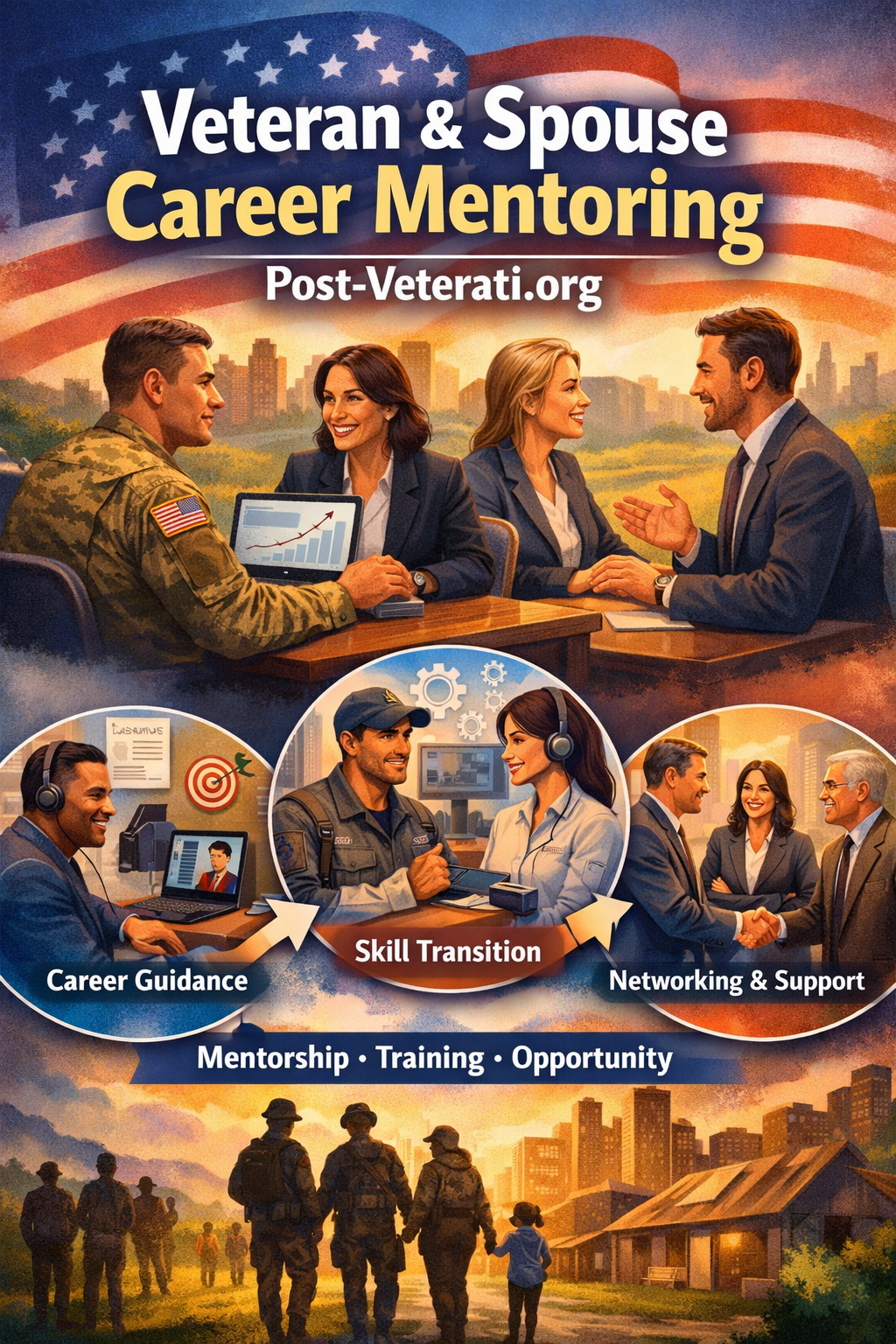 among military families. The transition from military service to civilian employment represents not merely a professional shift, but a structural reorientation of income, benefits, and long-term financial security. Scholarly literature consistently identifies employment continuity as a central predictor of post-service adjustment outcomes (Institute for Veterans and Military Families [IVMF], 2020; U.S. Department of Veterans Affairs [VA], 2022).
For veterans, military compensation is characterized by standardized pay scales, housing allowances, healthcare coverage, and predictable promotion structures. Upon separation, this institutional stability is abruptly replaced by labor market competition and credential translation barriers. Research indicates that veterans frequently encounter periods of unemployment or underemployment during the first years following transition, often earning below their military-acquired skill level (Kleykamp, 2013; Castro & Kintzle, 2016). This phenomenon, commonly referred to as “skills mismatch,” contributes to long-term wage penalties and financial instability.
A sustainable career pathway mitigates these risks by ensuring income continuity, access to employer-sponsored benefits, and long-term earnings growth. Unlike temporary employment, career trajectories allow veterans to accumulate retirement savings, establish credit stability, and build wealth over time. For those who separate prior to qualifying for full military retirement benefits, civilian career attainment becomes particularly critical for long-term financial independence (Congressional Budget Office, 2021). Employment, therefore, operates not only as an income source but as a stabilizing economic institution that supports reintegration.
Military spouses experience parallel yet distinct structural disadvantages. Frequent permanent change of station (PCS) relocations disrupt employment continuity and often require repeated job searches in new labor markets. Empirical evidence demonstrates that military spouses experience significantly higher unemployment and underemployment rates compared to civilian spouses, largely attributable to geographic mobility and occupational licensing barriers (Blue Star Families, 2023; Department of Defense, 2022). Professional credential transfer limitations across states further exacerbate these disparities.
The economic implications of spouse underemployment extend beyond individual earnings. Military households frequently become dependent on a single income stream, increasing vulnerability to deployment disruptions, medical discharge, or separation from service. Dual-career participation diversifies household income and enhances economic resilience, consistent with risk-distribution theory in household economics (Becker, 1981). Stable spouse employment also enables retirement contributions, sustained career advancement, and long-term wealth accumulation—protective factors against inter generational economic instability.
Moreover, financial strain has been empirically associated with increased marital stress, mental health challenges, and decreased overall family well-being (Karney & Crown, 2007). Thus, employment stability functions as both an economic and psychosocial safeguard. By securing career continuity for both veterans and military spouses, policymakers and institutions contribute not only to labor market efficiency but also to family system stability.
In sum, career access for veterans and military spouses represents a structural necessity rather than a discretionary benefit. It ensures income continuity, reduces underemployment risk, diversifies household earnings, and strengthens long-term financial security. As research consistently demonstrates, sustainable employment is central to reintegration outcomes, household resilience, and national workforce optimization. Addressing career barriers for this population is therefore both an economic imperative and a societal obligation.
Post-Veterati.org envisions a future where veterans and military spouses achieve economic stability, career continuity, and professional growth beyond military service. The organization is committed to reducing underemployment, strengthening dual-income resilience, and promoting long-term financial security for military families. Through initiatives such as its Military Spouse Mentorship Program, the organization advances career development, confidence-building, and workforce integration—ensuring that service and sacrifice translate into sustainable opportunity.
Identity, Purpose, and Psychological Well-Being: The Role of Career in Veteran Reintegration
The transition from military service to civilian life represents more than a change in occupation; it signifies a profound shift in identity, structure, and social belonging. For many service members, military life is not merely employment but a comprehensive identity system shaped by rank, mission, unit cohesion, and shared sacrifice. Upon separation, this integrated identity framework is disrupted, often resulting in psychological and social challenges that extend beyond economic adjustment.
Military culture provides a clearly defined hierarchy, mission-oriented objectives, and a collective ethos that reinforces belonging. Service members internalize roles tied to responsibility, leadership, and teamwork. Research on role exit theory suggests that when individuals depart from highly structured institutions, they may experience identity disorientation and diminished self-concept (Ebaugh, 1988). Veterans frequently report a sense of identity loss following separation, particularly when civilian society does not immediately recognize or translate their military competencies into meaningful roles. The absence of rank, uniform, and mission can create an existential vacuum—an erosion of the very markers that once defined daily purpose.
This disruption may manifest as reduced self-esteem, social withdrawal, and psychological distress. Studies have shown that transition periods are associated with elevated risks of depression, anxiety, and adjustment disorders among some veterans (Castro & Kintzle, 2016). The loss of camaraderie and structured accountability further intensifies feelings of isolation. In military environments, belonging is institutionalized; in civilian life, it must be reconstructed.
A sustainable career plays a critical restorative role in this process. Employment that aligns with skills and values helps reestablish purpose. A career introduces structure through schedules, performance expectations, and professional growth pathways. It provides an arena in which veterans can exercise leadership, problem-solving, and teamwork—core elements of their prior identity. Through professional integration, identity evolves rather than dissolves. The veteran identity becomes incorporated into a broader civilian professional self-concept.
Meaningful employment is also strongly associated with improved mental health outcomes. Occupational psychology research consistently links stable employment with lower rates of depression and anxiety, particularly among populations undergoing major life transitions (Paul & Moser, 2009). Work provides routine and predictability—protective factors that buffer against psychological instability. Moreover, accountability within a professional environment reinforces self-efficacy, a critical determinant of well-being.
Employment additionally fosters social integration. Workplace communities offer opportunities for interpersonal connection, mentorship, and collaborative engagement. These social networks serve as substitutes—though not replacements—for military unit cohesion. Over time, professional relationships can rebuild a sense of belonging within civilian society, reducing isolation and facilitating reintegration.
Furthermore, stable employment reduces risk factors associated with substance misuse. Economic stress, identity loss, and social isolation are well-documented contributors to maladaptive coping behaviors. By providing financial stability, daily structure, and social engagement, meaningful careers function as preventative mechanisms against such risks.
In sum, the importance of career access for veterans extends beyond income generation. It addresses a fundamental human need for identity, purpose, and belonging. Reintegration is not achieved solely through benefits or transitional programs; it is solidified through sustained participation in meaningful civilian roles. Career pathways therefore serve as psychological bridges—connecting past service with future contribution—and transforming separation from a rupture into a redefinition of purpose.
Post-Veterati.org envisions a reintegration landscape where veterans and military spouses rebuild not only their careers but also their sense of identity, belonging, and psychological well-being after service. The organization’s mission is to create structured pathways that transform transition into renewal—connecting transitioning service members, military spouses, and veterans with industry professionals through its new career-connection platform. By advancing mentorship, professional development, and community-based engagement, Post-Veterati.org positions meaningful employment as both an economic stabilizer and a critical protective factor for mental health, ensuring sustained purpose and social integration beyond military service.
Utilization of Skills and Training: Maximizing Human Capital Among Veterans and Military Spouses
The successful integration of veterans and military spouses into the civilian workforce is not solely a matter of employment access; it is fundamentally an issue of human capital utilization. Military service cultivates advanced competencies in leadership, crisis management, logistics, operations, and technical specialization. Yet without deliberate translation mechanisms and career pathways, these skills risk underutilization—resulting in both individual economic loss and broader inefficiencies within the national workforce.
Veterans exit service with extensive experiential training that often exceeds civilian counterparts in scope and intensity. Leadership development in military contexts includes high-stakes decision-making, team coordination under pressure, strategic planning, and operational accountability. Crisis management capabilities are refined through real-time problem-solving in unpredictable environments. Additionally, many service members receive advanced technical and logistical training in fields such as cybersecurity, engineering, aviation, healthcare support, and supply chain management.
Despite these assets, veterans frequently encounter challenges in communicating their competencies in civilian-recognized terminology. Military occupational specialties (MOS) do not always directly correspond to civilian job classifications. Employers unfamiliar with military structures may struggle to interpret rank responsibilities or operational experience. This disconnect contributes to underemployment, wherein veterans accept positions below their skill level or outside their field of expertise. Such mismatch not only diminishes earning potential but also suppresses economic productivity at scale.
Career pathways that prioritize skill translation and credential alignment mitigate these inefficiencies. Structured transition programs, employer education initiatives, and competency-based hiring practices enable the conversion of military experience into market-recognized qualifications. When effectively aligned, veteran employment enhances national workforce performance by injecting disciplined leadership, operational efficiency, and mission-oriented focus into civilian industries. In this sense, veteran career integration represents a return on public investment in military training and education.
Parallel challenges affect military spouses, particularly in professions requiring licensure or state-specific credentialing. Frequent relocations—often every two to three years—create systemic barriers to professional continuity. Occupational licenses in fields such as nursing, teaching, counseling, and healthcare administration may not transfer seamlessly across state lines. Even when reciprocity agreements exist, bureaucratic delays can interrupt employment for months. These disruptions produce what scholars describe as “career fragmentation,” characterized by repeated entry-level resets and interrupted advancement trajectories.
The consequences of credential transfer barriers are cumulative. Career regression reduces lifetime earnings and limits retirement contributions. Extended employment gaps may contribute to skill atrophy, as professional competencies deteriorate without consistent application. Moreover, repeated licensing obstacles can generate professional discouragement, eroding confidence and long-term career commitment.
Policies and employer practices that promote portability—such as interstate licensure compacts, remote employment opportunities, and expedited credential review processes—are critical to mitigating these effects. Portable careers reduce economic vulnerability and allow military spouses to sustain professional growth despite geographic mobility. By stabilizing employment continuity, families gain financial resilience and long-term economic security.
Ultimately, maximizing the utilization of military-acquired skills and mitigating credential barriers for spouses are not isolated workforce issues; they are strategic economic priorities. When veterans and military spouses are positioned in roles that fully reflect their competencies, the result is enhanced productivity, stronger household stability, and a more efficient national labor market. Failure to address these structural misalignments represents not merely individual hardship, but a collective underinvestment in proven human capital.
Post-Veterati.org envisions a workforce ecosystem where the skills, leadership, and technical expertise of veterans and military spouses are fully recognized, translated, and valued within the civilian economy. The organization’s mission is to bridge the gap between military-acquired competencies and industry requirements by facilitating skill conversion, credential alignment, and employer engagement. Through strategic partnerships and its career-connection initiatives, Post-Veterati.org works to reduce underemployment, address licensure portability barriers, and ensure that military families are positioned for sustained professional growth—transforming proven service-driven capabilities into measurable economic productivity and national workforce advancement.
Social Reintegration and Community Stability: The Role of Employment in Veteran and Military Family Well-Being
The transition from military service to civilian life entails not only economic adjustment but also social reorientation. Military culture is inherently community-centered, structured around unit cohesion, shared mission, and collective responsibility. Service members and their families live within tightly knit networks where support systems are embedded in daily life. Upon separation or relocation, this institutionalized community often dissolves, leaving veterans and military families to navigate civilian society with diminished social integration. Employment plays a critical role in restoring social connection and reinforcing community stability.
Military environments foster belonging through shared identity and interdependence. Units function as both professional teams and social communities, providing camaraderie, mutual accountability, and emotional support. When veterans transition to civilian life, this sense of structured belonging may be replaced by social fragmentation. Civilian communities tend to be less centralized, with relationships formed voluntarily rather than institutionally. Research on social capital suggests that diminished network density can increase vulnerability to isolation and psychological distress (Putnam, 2000). For veterans accustomed to collective engagement, the absence of immediate community can feel disorienting.
Meaningful employment serves as a primary mechanism for rebuilding social networks. Workplaces provide opportunities for professional relationships, mentorship, collaboration, and shared goals. Through daily interaction and team-based projects, veterans gradually reconstruct a sense of belonging within civilian contexts. Employment also facilitates community engagement beyond the workplace, introducing individuals to local organizations, professional associations, and civic initiatives. In this way, career participation enhances both bonding social capital (close professional relationships) and bridging social capital (connections across diverse groups).
For military spouses, employment likewise mitigates isolation, particularly following relocations. Frequent moves can disrupt friendships, neighborhood ties, and extended family support. Workplace integration offers continuity amidst geographic mobility, fostering peer networks that support emotional well-being and practical assistance. Over time, these networks contribute to a renewed sense of community identity within civilian environments.
Employment also functions as a stabilizing force within family systems. Economic security supports housing continuity, enabling families to maintain stable living arrangements rather than relying on temporary or transitional housing. Stable housing environments are associated with improved child well-being, educational consistency, and reduced behavioral stressors. When families are not compelled to relocate due to unemployment or financial strain, children benefit from uninterrupted schooling and peer relationships—critical components of developmental stability.
Moreover, financial and occupational instability has been empirically linked to increased marital stress and family strain (Karney & Crown, 2007). Unemployment or underemployment can generate tension related to income insecurity, role expectations, and future uncertainty. Conversely, stable employment reduces economic pressure, enhances role clarity, and strengthens household resilience. Dual-income participation further distributes financial responsibility, decreasing vulnerability to unexpected disruptions.
In sum, employment operates as a multidimensional stabilizer in the post-military transition process. It reduces social isolation by rebuilding professional and community networks, while simultaneously reinforcing family stability through economic security. Social reintegration is not achieved solely through community programs or transitional services; it is sustained through meaningful participation in civilian institutions. Career access therefore serves as both a social bridge and a structural anchor—linking veterans and military families to enduring networks of belonging and long-term community stability.
Post-Veterati.org envisions thriving veteran and military spouse communities anchored in connection, stability, and civic participation. Its mission is to strengthen social reintegration by fostering professional networks, mentorship, and employer partnerships that rebuild belonging beyond the military unit. Through career-centered programming and community engagement initiatives, Post-Veterati.org advances employment as a catalyst for social capital, housing stability, and family resilience—ensuring that military-connected families are not isolated in transition but embedded in sustainable, supportive civilian communities.
Strategic collaboration between Vets2Industry.org and Post-Veterati.org strengthens the continuum of support for transitioning service members, veterans, and military spouses. While Vets2Industry.org focuses on workforce access, employer engagement, and career readiness through industry partnerships, Post-Veterati.org advances mentorship, professional identity restoration, and long-term career integration. Together, these platforms create a complementary ecosystem—bridging skill translation with sustained community connection. By aligning industry exposure with structured reintegration support, the partnership enhances employment outcomes, reduces underemployment risk, and promotes both economic mobility and psychosocial stability for military-connected families.
Long-Term Economic Mobility: From Temporary Employment to Sustainable Careers
Long-term economic mobility for veterans and military spouses depends not merely on access to employment, but on access to structured, sustainable career pathways. The distinction between a job and a career is central to understanding economic resilience. While a job provides immediate income, a career offers advancement opportunities, benefits, professional growth, and retirement planning—components essential for financial stability across the life course (Becker, 1993). Human capital theory suggests that long-term earnings growth is directly tied to cumulative skill development and institutional investment in workers, distinguishing careers from short-term labor engagement.
Veterans entering the civilian labor market frequently encounter initial underemployment. Despite possessing advanced leadership, operational, and technical competencies, many accept positions below their qualification level due to challenges in skill translation and employer familiarity with military occupational specialties (Kleykamp, 2013). Research indicates that early-career underemployment can produce persistent wage penalties, limiting lifetime earnings trajectories and upward mobility (Abel & Deitz, 2016). Without deliberate career alignment strategies, these early mismatches may solidify into structural stagnation rather than progression.
Military spouses face comparable systemic barriers. Frequent permanent change of station (PCS) relocations disrupt employment continuity and contribute to elevated unemployment rates compared to civilian spouses (U.S. Department of Defense, 2022). Blue Star Families (2023) reports that military spouse unemployment rates remain significantly higher than national averages, largely due to mobility demands and licensing restrictions. Repeated career interruptions often result in lateral employment moves or acceptance of positions beneath qualification levels, thereby constraining long-term advancement and retirement accumulation.
Structured career programs serve as corrective mechanisms. Evidence suggests that targeted workforce integration initiatives—such as mentorship networks, credential alignment programs, and employer partnerships—reduce underemployment risks and mitigate long-term wage penalties (Institute for Veterans and Military Families [IVMF], 2020). By emphasizing career architecture rather than temporary job placement, such programs foster skill conversion, professional growth, and industry recognition of military-acquired competencies.
The implications extend beyond individual earnings. Stable career trajectories support wealth accumulation, homeownership, and retirement planning, all of which are associated with intergenerational economic mobility (Chetty et al., 2014). Moreover, financial insecurity has been linked to increased family stress and reduced household stability (Karney & Crown, 2007). When veterans and spouses secure sustainable career pathways, families experience greater resilience against economic shocks and long-term uncertainty.
From a macroeconomic standpoint, underemployment among veterans and military spouses represents inefficiency in human capital utilization. Public investment in military training, education benefits, and leadership development yields optimal returns only when those competencies are fully integrated into civilian industries (Congressional Budget Office, 2021). Career-focused reintegration strategies therefore function not only as social support measures but as economic optimization policies.
In sum, transitioning from job acquisition to career development is essential for breaking cycles of underemployment among veterans and military spouses. By aligning workforce integration efforts with principles of human capital theory and long-term mobility research, policymakers and organizations can transform transition into sustained economic advancement rather than temporary stabilization.
Post-Veterati.org envisions long-term economic mobility for veterans and military spouses through structured career pathways—not temporary job placement. Its mission is to build sustainable professional trajectories by connecting military-connected talent with industry leaders, mentorship networks, and advancement-focused opportunities. By emphasizing career architecture, credential alignment, and leadership development, Post-Veterati.org works to break cycles of underemployment, reduce lifetime wage penalties, and promote wealth-building capacity. Through strategic workforce integration, the organization advances economic resilience, retirement security, and intergenerational stability for military families.
National and Social Responsibility: Public Investment, Human Capital, and the Social Contract
The integration of veterans and military spouses into sustainable civilian careers is not solely a private matter of individual employment; it is a national economic and ethical imperative. Governments invest substantial public resources into military training, education benefits, leadership development, and technical specialization. Ensuring that these investments translate into productive civilian workforce participation represents both fiscal responsibility and social obligation.
Military service members receive extensive, high-value training funded by public expenditure. This includes advanced technical instruction, leadership development programs, operational logistics training, cybersecurity certifications, aviation skills, healthcare training, and strategic management experience. In addition, governments provide education benefits such as tuition assistance and GI Bill programs to further enhance service members’ competencies (Congressional Budget Office, 2021). These investments constitute deliberate human capital development on a national scale.
Human capital theory posits that investments in education and training increase productivity and economic growth when effectively utilized within the labor market (Becker, 1993). However, when veterans experience underemployment or prolonged unemployment, the nation fails to capture the economic return on its investment. Skill underutilization represents inefficiency—an erosion of potential productivity that could otherwise contribute to innovation, leadership, and industry advancement. From a macroeconomic perspective, misalignment between military-acquired competencies and civilian employment pathways results in a loss of trained human capital.
Moreover, workforce integration of veterans enhances institutional resilience across sectors. Veterans often demonstrate advanced leadership under pressure, operational discipline, and mission-oriented execution. These attributes are directly transferable to industries facing complex logistical and strategic challenges. When public investment in military development is fully integrated into the civilian economy, productivity gains extend beyond individual households to national competitiveness.
Beyond economic rationale lies a deeper moral dimension. The relationship between society and those who serve is grounded in an implicit social contract. Service members accept personal risk, mobility constraints, and family disruption in defense of national security. In return, society assumes responsibility for facilitating successful reintegration and opportunity after service. Political philosophers have long argued that social contracts require reciprocal obligation to maintain legitimacy and civic trust (Rawls, 1971). Providing meaningful career access functions as tangible recognition of sacrifice.
Failure to ensure workforce integration may erode public trust and weaken the perceived reciprocity underlying military service. Conversely, robust reintegration systems reinforce civic cohesion. When veterans and military spouses are visibly supported in achieving economic mobility, societal commitment to those who serve becomes demonstrable rather than symbolic.
Career access also functions as a stabilizing national policy measure. Economic instability among veteran populations is associated with broader social costs, including increased reliance on public assistance and healthcare systems. Conversely, stable employment reduces long-term social expenditure while strengthening tax contributions and community engagement. In this sense, career integration is both preventive and productive policy.
Post-Veterati.org envisions a nation where public investment in military training and education yields measurable civilian workforce impact and long-term economic strength. Its mission is to honor the social contract by transforming service-acquired skills into sustainable career opportunities through employer partnerships, mentorship networks, and industry alignment. By advancing workforce integration as both an economic strategy and a civic responsibility, Post-Veterati.org reinforces national trust, protects the return on public investment, and ensures that the sacrifice of service is met with structured pathways to enduring opportunity and societal contribution.
What Is Veteran and Military Spouse Career Mentoring?
Mentoring Veterans and Spouse Career Guidance for Post-Veterati.org refers to a structured, career-centered support system designed to help transitioning service members, veterans, and military spouses successfully navigate the civilian workforce. It is not simply job advice—it is a strategic, relationship-driven process that aligns military-acquired skills with sustainable civilian career pathways.
What It Involves
- Skill Translation and Positioning
Mentors help veterans articulate leadership, operational, and technical competencies in language civilian employers understand. For spouses, mentorship focuses on preserving professional identity despite relocations and addressing employment gaps strategically. - Career Pathway Mapping
Rather than focusing on immediate job placement, guidance centers on long-term career architecture—identifying industries, advancement ladders, credential requirements, and growth potential. - Industry Connection and Networking
Through structured engagement with industry professionals, mentees gain access to professional networks, informational interviews, and sector insights that reduce underemployment risk. - Confidence and Identity Reintegration
Mentorship supports psychological transition by restoring professional identity, strengthening self-efficacy, and rebuilding purpose beyond military service. - Credential Alignment and Portability Guidance
For military spouses, career mentoring includes navigating licensure portability, remote work opportunities, and strategies to maintain career continuity despite geographic mobility.
Related Articles: